Thursday, October 23, 2008

"And Now A Word from Their Cool College Sponsor"


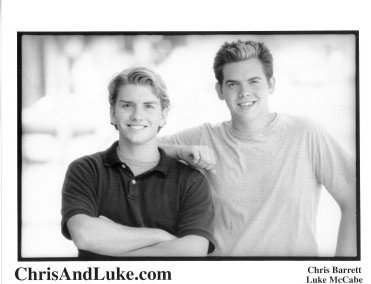
Two college students have really given a new meaning to the phrase “walking billboard.” Kate Zernike’s article, “And Now a Word from Their Cool College Sponsor,” introduces Chris Barrett and Luke McCabe, who have convinced the FirstUSA credit card company to put them through college. How did they do it? The boys agreed to become living, breathing advertisements for the company. In fact, the tagline of their website, chrisandluke.com, is “We wanna be your spokesguys.” Everything from their t-shirts to their surfboards is plastered with the FirstUSA logo. The duo also makes campus appearances, serves on a student panel, and maintain a website of financial advice for other collegians. Basically, the two needed a way to pay for college, and inspired by the high powered celebrity endorsement game, sold themselves to the highest bidder.

I waver between thinking these two are geniuses or complete sell outs. Perhaps they are both. I wouldn’t sign my life away, but the lure of a free college education (to great schools, mind you) is certainly enticing. It just seems so extreme and over the top, to sell your person as a form of advertising. However, this idea of walking billboards is actually more commonplace than you realize. We create free advertising when we wear clothing with prominently featured logos or insignias. Maybe I’ll make my own website after all – any takers? I could use a new car!

Monday, October 13, 2008

This Space Available for Advertising

Roy F. Fox made a very startling point in his article, “Salespeak.” When aren’t we exposed to some form of advertising? Even in my own living room, I can reach out and touch ads for Mead, Pepsi, and Walmart. This does not include the banner ads on my computer, or the stacks of magazines on the floor or the “Customer Appreciation” text messages – read “Buy more stuff!” ads – rotting in my inbox. Even, or perhaps especially, in a time of economic turbulence, advertising remains at the forefront of American life. As Fox said, “Salespeak is more than a voice we hear and see: we also wear it, smell it, touch it, play with it.” And, scarily enough, the advertising people are targeting younger and younger audiences. I work with three and four year olds who would make the marketing execs proud: when they get out their tool boxes during play time, they only use “Home Depot” tools. The kids can’t read, but they sure recognize that bright orange logo. In fact, one child yelled at another for saying he was going to the store, and not specifically a trip to Home Depot. Speaking of children and advertising, I found it disturbing that the article mentioned numerous school districts who have agreed to be giant billboards in exchange for money. Many of the tactics mentioned in school-advertising seem subversive and rather devious. Where’s the real focus here?

Sunday, October 5, 2008

Your friends are not the only people on Facebook anymore.

In an increasingly common trend, job employers and school administrators are logging on to the popular social networking sites to keep tabs on prospective candidates. What does this mean for the millions of young people who frequent these websites? A startling dose of reality for many – imagine losing out on your dream job because the interviewer found all those “crazy” college pictures posted for them neatly in public albums. Alan Finder discusses this phenomenon in his article “When a Risqué Online Persona Undermines a Chance for a Job.” He points out that users of Facebook and MySpace do not realize that once something is posted on the Internet, you can never have sole control over it again. Finder provides examples of many employers Google-ing would-be employees, only to find pictures of underage drinking, sexual rendezvous, drug use, and illegal behavior. It’s hard to refute picture evidence. Users of these websites also have the opportunity to list interests and activities. “Blowing things up” or “smoking blunts,” as mentioned in the article, is probably not the best face one can put forward.

This article should be a wake up call for the digital generation. It is almost impossible to keep something private on the internet. West Chester University made a slide show for the opening days of freshman orientation of all the people who formed an online group for getting “expletive-faced the first day of school.” Imagine walking in and seeing your face on the screen! Many popular figures and celebrities have also recently been embarrassed over the Facebook pages. Miley Cyrus, aka Hannah Montana, was blasted for risky pictures and online bullying. Notre Dame quarterback Jimmy Clausen came under heavy criticism for pictures of underage “Beer Olympics” online. These people have celebrity on their side…but most people my age can’t afford to lose out on employment because they handed over embarrassing evidence.

Sunday, September 28, 2008

"What's Wrong With Cinderella?"


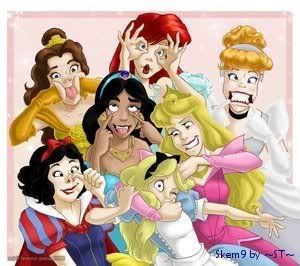
I can see where Peggy Orenstein’s article “What’s Wrong with Cinderella?” could incite panic among mothers. Orenstein voices her concern over the effects of “princess culture” on our little girls, that overkill on Disney’s end may contribute to unhealthy, un-empowered females later in life. She says that with 25, 000-plus available Princess products from Disney, everything from alarm clocks to undies, the “infatuation with the girlie girl” could in fact smother and oppress young girls. She suggests that this princess worship enforces patriarchal oppression, and creates “the” perfect model girls feel pressure to conform to. After all, Cinderella doesn’t really do anything, except get rescued by Prince Charming.

Or does she? I don’t think Orenstein gave little girls enough credit in her article. Little girls admire the princesses because their idols do have adventures. To a five year old, staying up all the way until midnight, or riding a flying carpet, or changing from a mermaid to a human is an adventure. When I was little, I thought those things were pretty cool! Also, the princesses present more of a capable, subversive edge than you would think. Cinderella endured a difficult life, while being the picture of stead-fastness and optimism. And – she snuck out and tricked her stepmother! “Beauty and the Beast’s” Belle, the town ‘bookworm,’ sought education and made personal sacrifices to save her family. Ariel of “The Little Mermaid” rejected the place her society held for her and sought a new, controversial life on the other side. In my opinion, there’s no need to yank your child’s princess crown away just yet.

Wednesday, September 24, 2008

If you could be anyone you wanted with a click of a button, who would you be? Would you switch genders, race, careers? This is the sort of freedom of expression on MMORPGs, or massive multiplayer online role playing games, like World of Warcraft and Second Life. In these games, users create avatars, or virtual people they sculpt for themselves to frolic in a virtual world. These characters can get married, buy, sell, and trade with other avatars, go to school, and even break the law. As Sege noted, these virtual worlds are even becoming political forums and advertising spaces for things in the “first life” or real world. The article notes that over a million people are logging in to these virtual lives.

I found the ideas posed in the article slightly disturbing. It is a necessary part of children’s development to experiment with role playing and imagination, but it seems that these MMORPGs are mainly used by adults. Take the man with shoulder length hair in the article. His avatar is a sexy, brunette in a short skirt. Or Jeff Lipsky, a white thirty something who masques as a black art gallery owner. As the article says, this speaks to the idea of presenting a different face depending on the social situation; people put on “work selves” and “home selves” and “neighbor selves.” It just seems that these services create a faceless system where people shed the responsibilities and decorum of face to face interaction. How can you trust anyone? And what could be so entertaining in virtual life, as opposed to “real life”? I also have a hard time with the fact that these MMORPGs are used as pedestals to talk politics, or cultural events like the Walk for Cancer. Why can’t these people participate in these events in real life? And Second Life as an educational tool? Yikes!

Sunday, September 7, 2008

Wiki-ty Wacked


(Image by Wilcox of Sydney Morning Herald)

Wikipedia…the high school student’s savior and the academic’s worst nightmare. Today’s encyclopedia has taken the shape of a free, “everyone’s-an-expert” group project. Developed by options trader Jimmy Wales, Wikipedia presents an easy, accessible interface that allows anyone with a mouse and free time to post, edit, and delete publicly shared encyclopedia articles. You want an article on the remote Romanian compound of Balaci, or the 18th century Polish nobleman Franciszek Grocholski? Both are just a Wiki-click away. However, say you are in need of a concrete, unbiased overview of the history of Islam? This is where things get tricky. Who’s to say the writers of these articles are truthful, factual, or complete? I could write “I HATE CATS” on fifty pages in less than a minute if I wanted to. Political parties can sabotage or mislead opponent’s pages. This conflict is the basis of Daniel H. Pink’s article “The Book Stops Here.” Is Wikipedia a romantic free-knowledge movement in which everyone has some area of ‘expertise’ to contribute? Or is it the literary equivalent of a “public bathroom,” as described by an Encyclopedia Britannica executive in Pink’s article because “who knows who used it last?”

I myself have a love-hate relationship with Wikipedia. It is perfect for a quick, mindless answer to some relatively unimportant question, or as a bridge to links and forums for further information. However, if I was betting my house (or my college term paper!) on my answers, I wouldn’t consult Wikipedia. As a future teacher, I cringe at the fact that young children take Wikipedia’s sometimes misinformed or biased information as factual. So what’s to do? Once something like Wikipedia has been unleashed, it can’t be stuffed back in the bag. I believe the only solution is the one proposed in Pink’s article: a forked Wiki-system of one unalterable, proven set of information, and one set of cutting-edge, up-for-grabs articles. Perhaps articles could be submitted for some sort of e-stamp of approval. While Wikipedia’s heart is in the right place, its format could use some editing.

Tuesday, September 2, 2008

"I'm just talkin' 'bout my g-g-generation..."


Imagine an alien drops into your backyard and asks you to describe this country. You’d probably have a much easier time giving him geographic and historical markers than providing a feel for the nation’s culture. Are we a country of ‘followers,’ absorbing what “pop culture” tells us is entertaining (Survivor) and mainstream (Abercrombie and Fitch) and creative (Kanye West)? Or are we a people individually dedicated to swathing our own paths of creativity; for example, look no further than the hundreds of indie artists on YouTube. It is this dual-cultural force that provides the basis for Bill Ivey and Steven J. Tepper’s article “Cultural Renaissance or Cultural Divide.” The authors explore the idea that recent, major advances in technology have changed the way we consume pop culture. They argue that with the ease of the digital age, people have taken charge of their own arts experience. We have the means and the choice to create whatever we want…and there is a deepening appreciation for the independent, the unique, the funky. Tepper and Ivey also examine the counterpoint of this thesis, that in fact technology has birthed a controlled, “narrow selection of preprocessed, corporate produced music, literature, movies, and TV” (31).


While this article took some wading through, I found it very interesting. Where do I stand along this cultural divide? I would like to think I am a creative, self-defining type. I enjoy painting, drawing and other fine arts and I have my own custom cake business. Technology has opened so many doors within these pursuits. I can Google paintings in the Louvre, or I chat with people online about the best way to make a cake that looks like a race boat. Rather than curtailing my creativity, technology has expanded to include all of my varied, odd little interests. However, I do realize that I fall into the mindless aspect of mass-consumer produced media. Sometimes, I tune out rather than participate in the arts experience. I flip on the radio and settle for what I’m told is popular (but really stinks) or see another bad movie for its special effects. However, it all boils down to whether you use technology to be a sheep, or a sheepdog. Can one avail oneself of the mass media, without disappearing into the masses? Technology can only diversify our culture if we allow it to.